Click the image above to watch…
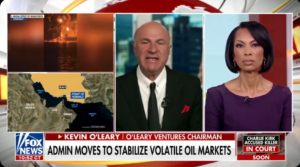
Kevin O’Leary just put the entire Iran war into its proper economic context — and the number is staggering.
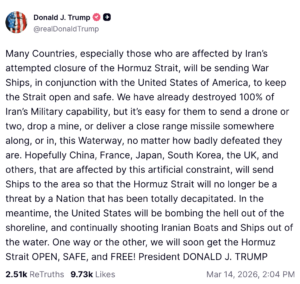
The U.S. has spent roughly $11-12 billion on Operation Epic Fury so far. That sounds enormous. O’Leary’s response: it’s a rounding error compared to what a closed Strait of Hormuz costs the global economy every single day.
Twenty percent of the world’s oil flows through that two-mile stretch of water. Every ally that buys American goods and services depends on it staying open. When it closes — or even when the threat of closure spikes — oil hits $100 a barrel, shipping costs explode, supply chains seize up, and the damage ripples through every economy on earth.
Iran has used that leverage for 40 years. Every time they wanted to throw a tantrum, they rattled the strait. The world flinched. Every time.
O’Leary’s guarantee: when this is over, that ends permanently. A coalition of countries that depend on the strait — starting with the Gulf oil producers who have the most to lose — will fund a permanent daily security force to keep it open in perpetuity. A billion dollars a month sounds like a lot. It isn’t. It’s a fraction of what one closure costs.
Think of it like the UN peacekeeping mission on Cyprus in the 1960s. You pay a standing force to prevent a catastrophe that costs ten times more when it happens.
For 47 years, the Iranian regime held a two-mile stretch of water over the head of the entire global economy. Operation Epic Fury is ending that arrangement — permanently.
That’s not just a military victory. That’s a generational economic one.
♦ Bonus ♦