


A round-up of articles on universal basic income, designed to whip up enthusiasm, get us over the hump of creation, and propel us into momentum.
In my opinion, this is our chance to bring in this eminently-worthwhile change to our economies – last stop before the Reval.
Second last stop before NESARA and a total change in approach to finances and life.
 Pope advocates for universal basic income in Easter letter
Pope Francis advocated for a universal basic income amid the coronavirus pandemic in an Easter letter to leaders of social movements and organizations around the world.
“This may be the time to consider a universal basic wage which would acknowledge and dignify the noble, essential tasks you carry out,” he wrote. “It would ensure and concretely achieve the ideal, at once so human and so Christian, of no worker without rights.”
In his message the pope acknowledged that the pandemic and subsequent economic shutdowns have hit “twice as hard” for those without any legal guarantee of protection.
“Street vendors, recyclers, carnies, small farmers, construction workers, dressmakers, the different kinds of caregivers: you who are informal, working on your own or in the grassroots economy, you have no steady income to get you through this hard time … and the lockdowns are becoming unbearable,” he wrote.
Several countries have said they will implement some form of a temporary or permanent universal basic income in response to the global pandemic.
Spanish Economy Minister Nadia Calvino said last week the nation intends to implement a universal basic income program as soon as possible.
In the U.S., some Americans will be receiving $1,200 checks as part of the $2.2 trillion coronavirus stimulus package.
The Internal Revenue Service (IRS) said Saturday the first stimulus checks were deposited into taxpayer’s bank accounts.
 It’s Time to Give Everyone Free Money
Universal basic income was once a fringe idea, but it’s rapidly gaining fans thanks to our current crisis.
Angus Harrison, Vice, 11 April 2020
https://www.vice.com/en_au/article/dygbvw/why-universal-basic-income-makes-sense
So, what do we do when the economy stops?
For a world that has been marching to the relentless beat of the market for centuries, we’ve never had a shock quite like this one. Many of us can’t work, and those who can are being asked not to in order to claim support. If we want to avoid total collapse, people need money in their pockets fast.
The UK government’s current coronavirus strategy is to provide people with wage subsidies – matching 80 percent of their monthly earnings, and calculating the same for the self-employed based on their last three years of tax returns. As many have pointed out, the implications of this strategy are bewildering. What if you only went freelance last year? What if you can’t wait until June for a payout? The scheme is both too complicated, and not complicated enough; too many people fall through the gaps.
Increasing numbers of people are calling for a Universal Basic Income (UBI): an unconditional cash transfer paid to every citizen once a month, for as long as the crisis continues. A UBI, they say, is the only policy measure that will ensure protection for everyone, while giving the economy the fuel it needs.
The popularity of a UBI has been growing steadily in recent years. It made it into the Green Party’s manifesto in 2015 and, had Labour won the most recent general election, Shadow Chancellor John McDonnell was committed to piloting it in various parts of the UK. Successful trials have already taken place in Finland, India and Canada. Former Democrat presidential hopeful Andrew Yang stood on a basic income platform, promising to pay every American adult $1,000 a month if he won the election.
It’s based on the premise that just like healthcare or housing, everybody is entitled to basic economic security. Long-term champions suggest it would boost wellness, stabilise the economy and can even encourage employment. And you can probably predict the objections: why do rich people need it? Won’t it stop people from working? And how much will it cost?
While there are rebuttals to all of these concerns, the idea of a UBI was treated as the ultimate fantasy: free money. Until a pandemic swept across the world that is, and the fantasy suddenly became the sensible option.
Professor Guy Standing has been advocating, piloting and writing about UBI for the best part of 30 years. He says, in all that time the policy has never seemed so feasible. In his most recent book, Battling Eight Giants, he argues that a basic income is the best tool for weakening the new evils of modern life, from debt to inequality to ecological disaster.
Coronavirus, he believes, has made this suddenly obvious to everyone. “People who’ve been attacking [UBI] for years are suddenly saying it’s the only thing to do,” he says, “I feel some of them should write to me with apologies!”
Globally the tide is certainly turning in UBI’s favour. Gyeonggi Province in South Korea have announced they will pay every citizen 100,000 won in April, Hong Kong are offering a one-off payment of HK$10,000, while the US Congress is currently debating an immediate payout to every family in America. As the UK continues to grapple with its ineffectual approach of delayed wage subsidies, the once-radical UBI is gradually becoming the logical, mainstream step to take.
“The real need is to give people security, which will give them resilience against the pandemic,” Standing says. “It’s not a panacea; it’s got to be introduced alongside other things, but it will at least declare: ‘We are all in this together’.”
Daniel Susskind, an economist and one-time policy advisor to David Cameron and Gordon Brown, has just published a book called A World Without Work, in which he explores various coping mechanisms for the gradual displacement of work due to automation. He’d previously been skeptical of UBI as the answer, seeing it as an “imperfect solution to a problem we don’t yet face”. He has since changed his mind.
“All the thoughts I had about UBI being something we didn’t need to engage with in the 2020s… I think those concerns are being put to one side,” he explains over the phone. “It strikes me that a temporary UBI is, administratively, the quickest way to relieve the financial pressures many people are now under.”
In a recent column for the Financial Times, he suggested giving every person in the UK £1,000 a month for a few months. “The point of picking the number was to show that even if you gave people that much, even if you gave £1,000 a month to everyone in the country for a few months, the cost would still be in a similar ballpark to the bailout during the financial crisis,” he continues. “Only this time, rather than bailing out the banks we’d be bailing out people and small businesses, which is quite compelling.”
That’s all well and good, but how do you get a Conservative government to agree to something as radical as a basic income? Despite increasing pressure from MPs and Lords, economists and analysts, not to mention popular support, Chancellor Rishi Sunak has ruled it out, leaning on the simplistic objection that too many people who don’t need it would receive it.
Guy Standing remains optimistic that the obviousness of UBI as a solution, versus the chaos of any alternative, will see it realised.“I think it’s going to be down to those of us supporting it to put virtual pressure on our politicians,” he says, “but I’m quietly confident.”
The question is then whether adopting a UBI as part of a “wartime economy” would convince people of its benefits long-term. Promoters of the policy believe it offers economic stability in good times and bad. While the cost would be considerable, there are plenty of options – adjust tax rates on top earners, create a carbon tax, cut defence spending. If it has the impact many think it will, UBI may be a difficult thing to take away again once adopted.
Standing believes the fallout from coronavirus will make it more essential than ever. “Inequality is growing, debt will be explosive, precarity will rise, stress, of course, will grow,” he says. “You’ve got to have policies that cut through that… weaken the giants.”
Susskind also believes the government will struggle to recede back to free market conservatism after this. “I think it’s far bigger than a UBI,” he says, “I think it’s more about the role of the state in the future, and how we protect one another from the sorts of shocks we’ve seen in the past few weeks.”
This article originally appeared on VICE UK.
 Reese: Universal Basic Income Isn’t Radical
April 12, 2020
https://dailyutahchronicle.com/2020/04/12/reese-universal-basic-income/
The world is teetering under the mortal and economic consequences of the COVID-19 pandemic. Because of necessary social distancing practices, a massive recession is expected to hit the world and U.S. economies. Panic and mass hysteria have consumed the U.S. population as people hoard supplies necessary to survive a long period of self-isolation.
This outbreak has already illustrated the brokenness and instability of America’s health care and economic systems — it is clear now, if it wasn’t before, that we needed drastic policy change yesterday. A society underpinned by a patchwork of limited financial safety nets, unaffordable and inaccessible healthcare and an economy burdened by ubiquitous inequality cannot begin to weather a crisis like this once-in-a-century pandemic. Progressive policies are necessary now to provide relief and will be needed, in the months and years to come, to reshape post-pandemic America. Universal basic income is one policy America needs in order to survive in times of national and regional crisis and thrive in times of peace.
Existing Economic Needs
About 78% of Americans currently live paycheck-to-paycheck. The COVID-19 crisis has forced service jobs and businesses to shut down in order to protect public health. Unemployment claims across the U.S. have skyrocketed as jobs are lost every week. This has left millions of the same workers who cannot afford to build their savings to weather this kind of emergency without income or any way to sustain themselves during the crisis.
Even before the outbreak, a $10 hourly wage — let alone the federal minimum wage of $7.25 — was woefully insufficient to meet basic needs like food, shelter and clothing. In Utah, 27% of workers make around $10 per hour and the vast majority of those are adults over the age of 25. Nationwide, 41.7 million workers earn under $12 an hour and 58.3 million workers earn under $15 an hour.
From Radical Idea to Bipartisan Support
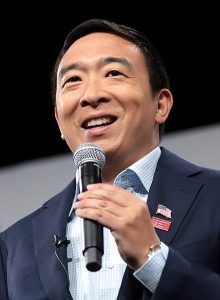 Former presidential candidate Andrew Yang made universal basic income a major part of his platform. This idea is gaining more traction in the context of the COVID-19 pandemic. (Courtesy Wikimedia Commons)
Against the backdrop of low-wage America, a universal basic income policy became a part of the national dialogue during Andrew Yang’s 2020 campaign for president. Initially, the idea was considered unrealistic, and it polled poorly among Americans. Since the end of his campaign, Yang has started an organization called Humanity Forward to continue to push his campaign’s platform. In Washington, D.C., policies like Yang’s have already been implemented as part of a major coronavirus relief deal.
Early in this crisis, Republican Senator Mitt Romney floated the idea of giving every American adult $1,000 during the outbreak — though universal basic income is generally viewed as a liberal or socialist policy goal — and he left open the possibility of making the payments monthly. The Trump administration has signed off on a $2 trillion stimulus bill with a tenet similar to universal basic income. Under the bill, most independent single Americans will receive $1,200 in their accounts and couples will get $2,400 with an addition of $500 per child. Unfortunately, adults who are still claimed on their parents’ taxes as dependents will not receive the check, which cuts out many young Americans who work service jobs.
A one-time payment of, at most, a few thousand dollars per household (and less in some cases, when incomes are greater than a certain threshold) will provide some temporary relief to economically imperiled Americans. Unemployed Americans might be able to meet their basic expenses for a month, perhaps two. But a permanent or longer-term universal basic income policy would allow them to have enough food, shelter and other necessities to live comfortably beyond a time horizon measured in months or even weeks. Clearly, this crisis will last much longer than a month.
While Romney’s plan is a good start and there is some relief on its way from D.C., Rep. Maxine Waters has proposed a stimulus package that goes further and will last as long as the crisis itself. Waters’ plan provides $2,000 for every adult and $1,000 for every child within a household for every month of the crisis. With a progressive plan like this, Americans would not have to contemplate the grim reality bearing down on them as soon as Memorial Day weekend.
A Basic Expectation
I used to be against universal basic income myself. The idea, at least on the surface, seemed like the equivalent of a tech-bro apologizing to the working class for automating their living-wage jobs out of existence. It struck me as a clever way for the privileged to assuage guilt rather than a sound economic policy. Now, while I do not think universal basic income is a cure-all for systemic economic inequality, it is clear to me that we should have implemented this policy a long time ago. When the pandemic instantly eliminated jobs, people were rightfully worried about how to keep a roof over their heads and food on the table. People need assurance that they can provide for themselves and their families — reassurance that a national emergency will not destroy their lives in the span of weeks.
Sam Altman, president of Y Combinator, an organization that nurtures tech start-ups, is an advocate for universal basic income. Altman wrote four years prior to this crisis that, “50 years from now, I think it will seem ridiculous that we used fear of not being able to eat as a way to motivate people.” Altman seems to intuit that if people are freed from the daily struggle for mere survival, many will ultimately prove themselves to be a great benefit to society, creating more economic and intrinsic value than the sum total of their universal basic income payments.
Yang’s argument for universal basic income was based around these same ideas. When people’s basic needs are met, they can focus on other pursuits and demands. If Americans had a universal basic income before this pandemic, they would be secure in the knowledge that they have enough money to keep them fed and sheltered, thereby making self-isolation more realistic and more widely practiced. Increased self-isolation would have led to a reduction in mass infection, which would have considerably lessened the economic tsunami that is playing out before our eyes and dwindling bank accounts.
Like Social Security, universal basic income is one of many progressive policies that are often called “radical” upon introduction to the national consciousness. However, once the dialogue surrounding universal basic income is stripped of contrived hysteria, breathless hyperbole and misstated fact, the premise makes sound economic sense. Not only would a universal basic income provide economic security for America’s poor and working classes, but it would also lead to stability among all socioeconomic classes. After all, a cooperative and mostly content populace is integral to national prosperity and economic growth. Nothing could be more antithetical to that than a nation shamed by the disgrace of millions of hungry, sick and homeless people roaming squalid streets. That is a universal, basic expectation that is far from radical.
/https://www.thestar.com/content/dam/thestar/business/opinion/2020/04/11/pms-covid-19-aid-underlines-the-potential-benefits-of-universal-basic-income/ubi.jpg)
PM’s COVID-19 aid underlines the potential benefits of universal basic income
By Amir Barnea, Toronto Star, April 11, 2020
Imagine that upon entering the COVID-19 crisis we had a universal basic income (UBI) program in place. If UBI were to be implemented, every adult would receive a fixed monthly payment from the government independent of his or her employment status. No questions asked, no forms to fill out. Direct deposit into your bank account.
Consider a payment of just $1,000 a month, as U.S. Democratic party ex-candidate Andrew Yang proposed in his campaign. This could have gone a long way toward relieving the stress so many people are experiencing right now.
With massive layoffs already taking place, the closure of anything non-essential and a severe recession around the corner, UBI could ensure that utility bills are paid and food is in the fridge. This is priceless in such extraordinary times.
The idea of UBI has been around for many decades. In fact, two pilot programs were already introduced in Canada. The first took place in Dauphin, Man., from 1974 to 1979, when the so-called Mincome program provided cash payments to low-income households.
The second pilot took place in 2018 in different communities in Ontario (Thunder Bay, Brantford and Lindsay among them). Four thousand people participated in the pilot, but it was terminated prematurely once Doug Ford’s government came into power.
While a final report summarizing the Mincome experiment in Manitoba was never published, in recent years Evelyn Forget, a professor at the University of Manitoba, analyzed the old data and concluded that UBI is still relevant, and recommended its implementation as a complementary measure.
Surprisingly, UBI is one of those ideas that people from both the economic right and left get excited about. They like it for very different reasons, but it still may increase the likelihood of being adopted by policy-makers.
So why is UBI a good idea? The socially minded see two major arguments in its favour.
The first: to reduce the breadth and depth of poverty. A UBI would effectively lift everyone above the poverty line, defined in Canada as the cost of a basket of goods and services that individuals and families require to meet their basic needs. UBI would let everyone live with dignity.