


A roundup of articles on the status of the Coronavirus and ways we can help….
There are so many stories coming out now, we’ll need to post several roundups throughout the day….

SEATTLE, WASHINGTON – MARCH 16: Washington state governor Jay Inslee talks at a press conference about the coronavirus outbreak March 16, 2020 in Seattle, Washington. Gov. Jay Inslee ordered all bars, restaurants, entertainment and recreation facilities to temporarily close to fight the spread of COVID-19 in the state with by far the most deaths in the U.S. from the disease. (Photo by Erika Schultz-Pool/Getty Images)
Why Coronavirus Relief Needs to be Permanent
Megan Wildhood, Yes! Magazine, March 20, 2020
https://www.yesmagazine.org/opinion/2020/03/20/coronavirus-relief-permanent/
As mass cancellations of public gatherings including sports events, concerts, church services, K-12 school closures, college and university classes moving online, and social distancing sweep the country as precautions because of the coronavirus disease, COVID-19, adverse economic impact is upon us and has been projected to worsen in coming months.
Therefore, we need to be intentional about strategizing to create a society that on the other side of this pandemic works for all of us. Some examples of how this can be done are already emerging.
The common reassurance that “only” those with underlying health conditions and those over 60 are at risk, in addition to being ableist and ageist, also encourages individualism and an attitude of taking care only of one’s self and loved ones. Those of us who are older and/or immunocompromised and at higher risk than young, healthy, able-bodied people appreciate those who are doing what they can to stop the spread of this virus, instead of hiding out until the outbreak passes and things “go back to normal.” But we all have to recognize that this pandemic is offering us an opportunity to see where our weaknesses as a society are and to come up with effective sustainable solutions.
Sustainable examples of a new system are emerging.
When health insurance is tied to employment, those who are unemployed or underemployed and those who may have full-time work but the employee contributions to premiums for adequate coverage are out of reach, can’t afford to stay healthy. Thus, they are more vulnerable to infections of all kinds, particularly vicious viruses like the current specter. The more people who get sick, the greater the number of people who are at risk of getting sick.
It is not just detrimental to narrow one’s focus to only making sure one’s self is taken care of—in a pandemic, that’s impossible. While the federal government struggles to pass COVID-19-relief legislation that would include making all testing for the virus free, Colorado’s Department of Public Health and Environment has opened up the state’s first walk-in COVID-19 testing facility.
Other states also have been moving forward despite bureaucratic delays, including enacting COVID-19-related legislation, and public health departments have been responding much more quickly to their own community’s needs, including putting together resource pages and regularly updating them. The Colorado Department of Public Health and Environment has created a data-visualization site to track COVID-19’s spread across the state. But it’s going to take more than these efforts in a few states and municipalities to slow down the spread of infections and preventing pandemics. Single-payer health care is essential in this regard.
Similarly, the ramifications of being the only one in 22 wealthy countries that does not guarantee workers some form of paid sick leave means that low-wage workers like food-service professionals who are unwell have to choose between starving and going to work ill—when their places of employment are open, that is. So even if you’re not a food-service worker and don’t know anyone who is, your risk as a member of the public who relies on services that workers who have no paid time off provide is increased.
Of course, the mandatory closures being implemented across the nation are going to cause many restaurants to close permanently, leaving thousands without employment. Before mandatory closures was implemented, Colorado had issued new rules mandating paid and unpaid sick leave for qualified workers. While many of those who are facing job loss because of the shutdowns may be able to receive unemployment, Colorado’s plan to pay food workers to take time off might have helped more restaurants survived the COVID-19 crisis.
The damage, created by emergency measures that in our current society are necessary, has hit restaurants as well as small businesses hardest, which strips communities of their unique character. It’s not just about cities retaining their individuality: As the world of biology has taught us, diversity is the key to resilience.
That’s why Seattle’s plan, announced by Mayor Jenny Durkan last Thursday, to spend $1.5 million on grants of up to $10,000 to small businesses who are struggling because of COVID-19 should be one thing that spreads to other cities. The Seattle Foundation has created the COVID-19 Respond Fund will support organizations on the front lines and who work with those disproportionately affected by the outbreak.
Celebrated author of So You Want To Talk About Race and other books, Ijeoma Oluo, a Seattle native, has launched a relief fund to help her city’s art community. In less than a week after going live, Seattle Artists Relief has raised more than $40,000 of its stated $100,000 goal, which should be encouraging to other artists, writers, and members of the gig economy who have larger platforms and name-recognition they can lend to the cause of supporting small businesses and creators through the economic contractions that pandemics tend to cause.
Just as the city is finding money to support small businesses, so should it find the money to put toward housing. The housing crisis in this country preceded the COVID-19 crisis, but the two are likely to worsen each other. As the economic impacts of COVID-19 shutdowns deepens, more and more people are at risk of joining the already swelling ranks of the unhoused.
Those who live outside cannot regularly wash their hands or easily find a pair of gloves to wear, can’t care for their immune systems by getting sufficient sleep and eating nutrient-rich foods. So they are at higher risk, as are the millions of social workers, service providers, crisis workers, community mental-health counselors, caregivers, shelter workers and others who work closely with them.
Public health departments have resources such as communication networks and emergency-planning resources on their websites; King County’s Public Health department runs the Healthcare for the Homeless Network, often underutilized simply because community members who don’t know about them or who can’t access them in their own languages.
As yet another example of why it’s important to keep local arts communities strong, Seattle-based artist Yadesa Bojia decided to take action when he realized, through talking with members of the Ethiopian community in his native language of Amharic, that there was a lot of confusion surrounding the virus.
He made a Facebook Live explaining recommendations, precautions, and resources in Amharic and the video has been viewed more than 2,000 times. COVID19MutualAid, a Facebook group and Instagram page that has created a GoogleDoc that can be viewed in English and Spanish to coordinate volunteer support.
Banning large gatherings and citywide quarantines, should be followed. They will also cause damage that will likely outlast whatever temporary relief governments, organizations, and citizens put together now. What we need is a permanent culture of mutual aid, one where all of the efforts discussed above are constantly being created and sustained perpetually not because of an emergency but because that’s what brings social and economic justice to all.
It’s time to push our leaders to replace their short-term view of maintaining until things can go back to normal (as in, the conditions that make pandemics possible) with the bigger vision of a sustainable society that always cares for what its members need.

Steve Appleford, Fast Company, March 21, 2020
Facing a health emergency, California legislators call for a moratorium on evictions, utility shutoffs and foreclosures.
The red banner raised outside a modest suburban home in East Los Angeles was a dramatic new addition to the neighborhood. “Reclamando nuestros hogares,” it read in big block letters. It translates roughly as “Reclaiming our homes,” an explicit statement of protest and personal survival at a time of crisis on this quiet stretch of Sheffield Avenue.
Inside, Martha Escudero, 42, and her two young daughters, ages 8 and 10, were still settling in three days after the family and several community activists took control of the empty bungalow. The March 14 takeover was the first step in an ongoing campaign to provide shelter to homeless and housing-insecure Angelenos through the distribution of state-owned properties, just as the coronavirus pandemic reaches a crisis point.
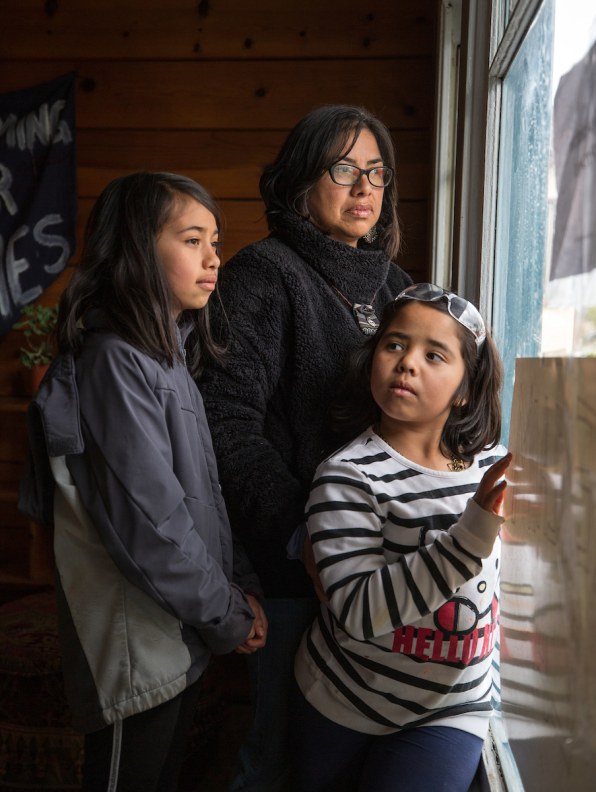
Martha Escudero with her two daughters, —Victoria (left) and Meztli, in the El Sereno home she seized two days before with Reclaim LA. [Photo: Steve Appleford/courtesy Capital & Main]
“We’re not squatters,” said Escudero, a former social worker who has been unable to afford to rent a home of her own since returning from living in Chile last year. “We’re retaining something that’s ours because it’s state-owned. We’ve been paying taxes all these years while they’re sitting vacant.”Escudero was referring to the fact that the light-blue stucco home is one of 460 properties purchased by Caltrans decades ago for a now-abandoned plan to extend the 710 Freeway. About 200 of those properties sit empty today, including dozens in L.A.’s working-class El Sereno neighborhood, said community activist Roberto Flores, 72, a member of United Caltrans Tenants and Reclaim Our Homes. Caltrans rents out the remaining properties that it acquired.
The action taken by Escudero was inspired by Moms 4 Housing, a group of working mothers who took over a vacant house in West Oakland last November, amid a worsening housing shortage in the Bay Area. In East L.A., the multiple homes left empty by the state could no longer be ignored by housing activists.
“The most vulnerable people [living] on the streets—children in cars, the seniors—they need to be housed immediately,” said Escudero. “There’s enough housing for all these people. They need to work faster on this, especially now with this pandemic.”
Last Saturday morning Escudero entered the two-bedroom home that had been forcibly entered the previous night and left unlocked by supporters of the group. Later, volunteers helped load in tables, chairs and inflatable mattresses from a curbside U-Haul truck. Los Angeles Police Department officers were present but did not intervene.
One banner read: ‘Shelter in the Storm’
“I want to fix it. I want to fix the garden, the inside, and make it my home,” said Escudero. Soon after she moved in, the house had water service but no electricity.
In the days that followed, volunteers worked with shovels to turn the backyard into a garden, while others in front of the house planted pomegranate bushes as children played nearby. In the windows, messages placed beside a faded U.S. flag decal proclaimed: “Housing is a human right,” “Reclaim LA” and “Self-quarantine in process.”
On March 18, the group seized nine more Caltrans homes in the same neighborhood. At one house a new banner was raised: “Shelter in the Storm.”
“We know that three houseless people die on the streets of L.A. every single day,” declared pastor Stephen Cue Jn-Marie from the home’s front steps. “That was before the coronavirus.”
Among those taking the new homes were Ruby Gordillo, 33, and her three children; and Benito Flores, 64; all had originally joined Escudero at the first house.
The group, with assistance from the Alliance of Californians for Community Empowerment (ACCE), had been planning these actions long before the virus became the urgent health emergency it is today, but its presence only made their cause more pressing, organizers say.
“Another tragedy has come to us that has exposed more of a need to get the families into a home,” said Roberto Flores, also a co-founder of a crucial community center, the Eastside Cafe.
California has one of the nation’s highest poverty rates and, according to a 2018 study from the U.S. Department of Housing and Urban Development, is home to a quarter of the nation’s homeless. In 2019, almost 59,000 homeless people were counted in L.A. County alone. Nearly 70 percent of them live on the street, in parks or other temporary spaces.
In a letter sent last weekend in response to the home seizures, California Assembly members Richard Bloom and David Chiu urged Gov. Gavin Newsom to “act boldly and rapidly,” and clear a path for the houses to be opened to “occupancy in a fair and systematic way.”
As members of the newly formed California Legislative COVID-19 Housing and Homeless Urgent Action Group, Bloom and Chiu noted that the virus only compounds the urgency of an existing crisis in homelessness. The Democratic legislators called for a moratorium on evictions, utility shutoffs and foreclosures.
Roberto Flores believes the letter to Newsom helped create an understanding that led LAPD responders to “stand down” after Escudero entered the house. But that successful first home seizure followed a tense night, during which the group’s initial attempt to seize four homes hit a roadblock.
Last Saturday, at 4:30 a.m., a van with Escudero and her daughters backed up the driveway of a small single-family home. In the windows were signs reading: “Trespassing, loitering forbidden by law.” Yellow caution tape stretched across the back gate.
Three years ago I was paying $1,200 for rent for two bedrooms and now it’s over $2,000, and I can’t afford it.”
Martha Escudero
Prices for a small home in El Sereno typically start at $500,000, and this one had clearly been unoccupied for several years. Yet it wasn’t an eyesore, with a palm tree towering overhead and a lawn that had been trimmed at some point in the previous month.
Escudero and the kids quietly exited the van and began to unload some belongings, then the mother walked up the steps to the door. She reached for the handle. It was locked.
After a couple of minutes, everyone left, stopping at a nearby gas station for coffee. Suddenly a police cruiser roared past and toward the house with lights flashing and siren blaring. Soon a pair of police helicopters hovered above, shining a spotlight on the neighborhood.
Someone in the area had apparently alerted police to activity around the empty houses—it was only by chance that Escudero and her family were not inside the house when the police arrived. Before sunrise, two men were stopped and cited for misdemeanor trespassing in connection with Saturday’s actions.
The activists successfully took control of a different house the next morning, and Escudero moved in. They celebrated with an interfaith vigil that included Christian ministers, a rabbi and a member of the Native American spiritual community. They sang “This Little Light of Mine” and other spirituals from the civil rights movement, along with Mexican folk songs.
“That was really uplifting,” said Escudero. “In all faiths, they were able to support us and state how immoral it is to have these vacant homes while people are suffering on the streets and do not have a home.”
‘I just try to do the best for my family’
Soft-spoken and dressed neatly in black, Escudero does not fit the easy stereotype of a homeless person. She earned a degree in gender and ethnic studies at Cal Poly Pomona, and she spent part of the day before Saturday’s home seizure at a public library.
Beside her was a stack of Harry Potter books for her 10-year-old, Victoria.
Looking toward the night that lay ahead of her, she said, “I have a lot of mixed emotions. I am excited and a little nervous. I really don’t know what the outcome’s going to be, but I am hopeful the governor is going to empathize with this.”
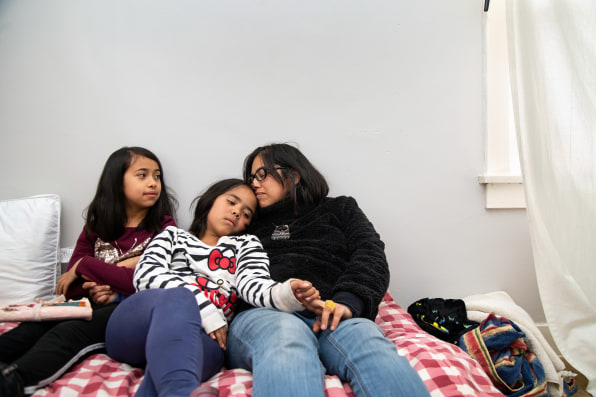
A daughter of Mexican immigrants, Escudero grew up in East L.A. and South Los Angeles, while her father worked at Kaiser Aluminum in the City of Commerce.
“He’s been living here since the ’70s and he doesn’t speak English,” she said of her Teamster father. “He was a janitor [and] able to afford a house back in the day. I’m born and raised here in the United States, I have a college degree and I can’t afford to buy or rent a place here.”
She was politically active as a student, and involved in protests at South Central Farm, a celebrated and controversial community garden that stretched 14 acres in the heart of industrial Los Angeles. When the local farmers were evicted in 2006, Escudero was among the protesters detained at the bottom of a walnut tree where actress Daryl Hannah was also arrested.
“I feel strongly about a lot of things and I do my best to be involved, but I’m first and foremost a mom,” she said of her activism now. “I just try to do the best for my family.”
As a social worker, Escudero dealt with high-risk mothers: those suffering abuse, teenage moms, low-income women with mental health issues or other health problems. Even then, she had to use food stamps to make ends meet.
Escudero moved to Chile for two years with her daughters and their father, living a mostly quiet rural existence. When she returned to Los Angeles in 2019, her comfort level with the city had shifted.
“I had become accustomed to [a] slow pace and less people,” she recalled. “I had culture shock [in Los Angeles] and really bad anxiety, where I couldn’t get out of my house.”
Her parents already lost their home during the 2008 financial crisis and had separated. And homelessness in L.A. was now worse than she had ever seen: “The tents are all over. It’s not just on skid row anymore.”
With no full-time job, Escudero and the kids had to stay with her mother, among other relatives sharing a crowded apartment. Without that, Escudero said, she would be in a shelter or worse: “Three years ago I was paying $1,200 for rent for two bedrooms and now it’s over $2,000, and I can’t afford it.”
Last year, a friend from her time at South Central Farm connected her to Amy Schur, campaigns director of ACCE, a statewide organizing group supporting tenants’ rights, rent control and homeless issues. It was the first step Escudero took toward taking control of her own home.
“If the government can’t take responsibility and can’t do their job, then the community has to step up and do it for them,” Escudero said. “There’s so many people on the streets, and we could literally house everyone that’s homeless if we were able to get a hold of these public-owned houses and vacant lots. It’s unbelievable to me.”
The collection of empty homes in El Sereno emerged from an era of boom times for infrastructure and a more ruthless approach to eminent domain.
The state began buying homes, apartment buildings and empty lots in the area back in the 1950s, with plans to level everything for an extension of the 710 Freeway between Pasadena and Monterey Park. After six decades of legal challenges, environmental impact reports and a multitude of plans (placing the proposed extension both above-ground and underground), the 710 extension was finally killed in 2018.
Over the years, that has put the transportation agency in the role of landowner and landlord. According to Roberto Flores, Caltrans hasn’t been very good in that role.
“They’re slumlords,” he said. Some homes have mold, and others are simply dilapidated, while some tenants have been forced to leave. Caltrans did not respond to a request for comments for this story.
With the freeway extension dead, the agency’s uncertain stewardship of hundreds of homes originally set aside for the wrecking ball has left a large number of properties vacant at the very moment that housing shortages and homelessness are at their most acute.
The first house seized by Escudero and her little girls, followed by more families in another nine homes, could be the start of a new movement.
“So we’re there now and it’s been very good,” Flores added. “We’re just trying to talk to neighbors and explain to them what this is all about.”