


A roundup of articles on the status of the Coronavirus and ways we can help….
6 Ways You Can Help Your Community Respond to Coronavirus
From relief funds to virtual companionship, we can all support others in tackling coronavirus.
https://www.globalcitizen.org/en/content/help-communities-responding-to-coronavirus/
The COVID-19 coronavirus pandemic is upending daily life for millions of people worldwide.
More than 194,000 infections have been confirmed so far and more than 7,500 people have died, according to the World Health Organization (WHO).
And that’s just the tip of the iceberg, WHO warns.
As the health crisis deepens, other crises are emerging. Lost jobs, mounting debts, looming evictions, and social isolation are just some of the disruptions societies are facing.
“One thing that the pandemic is doing is laying bare the lack of baseline universal infrastructure that is meant for all of us,” Celina Su, the Marilyn J. Gittell Chair in Urban Studies at the City of New York Graduate Center, told Global Citizen. “The pandemic could end up exacerbating inequalities and deepening poverty, but it’s also a canary in the coal mine by showing us in really tragic ways where we could all end up if we’re not as lucky later on.”
“It shows us what we should be working toward always, not just in times of crisis,” she said, calling for universal health care, free child care, paid sick leave, unemployment benefits, and a stronger social safety net.
Amid the growing crisis, communities are showing inspiring solidarity, helping the most vulnerable face challenges and building networks for long-term assistance.
“Right now, we’re supposed to be practicing social distancing, but how can we also practice social caring, social embracing, and social connection, all while physical distancing,” Su said. “What does that look like?”
Here are six ways communities are stepping up to support people and how you can join the relief effort.
1. Relief funds
As governments restrict public gatherings to slow the outbreak, businesses are getting shut down and people are losing their jobs around the world.
Many of these people — especially undocumented immigrants — have little savings and could lose their homes, run out of food, and be unable to pay essential bills for the foreseeable future.
Governments globally are developing emergency relief packages to ease the burden, but in the meantime communities are creating crowdsourced relief funds to help people in need.
The C19 Help Squad is providing immediate financial assistance to people throughout the US, while people in the UK have rallied to create more than 720 mutual aid groups, and crowdfunding sites like GoFundMe have set up dedicated pages.
Some businesses that have been forced to shut down to prevent public gatherings are also setting up relief funds for their employees and to ensure they can return to work once the pandemic passes.
You can look for ways to help people in your community who are struggling financially by searching on social media, crowdfunding sites, or Google for local funds.
2. Food banks
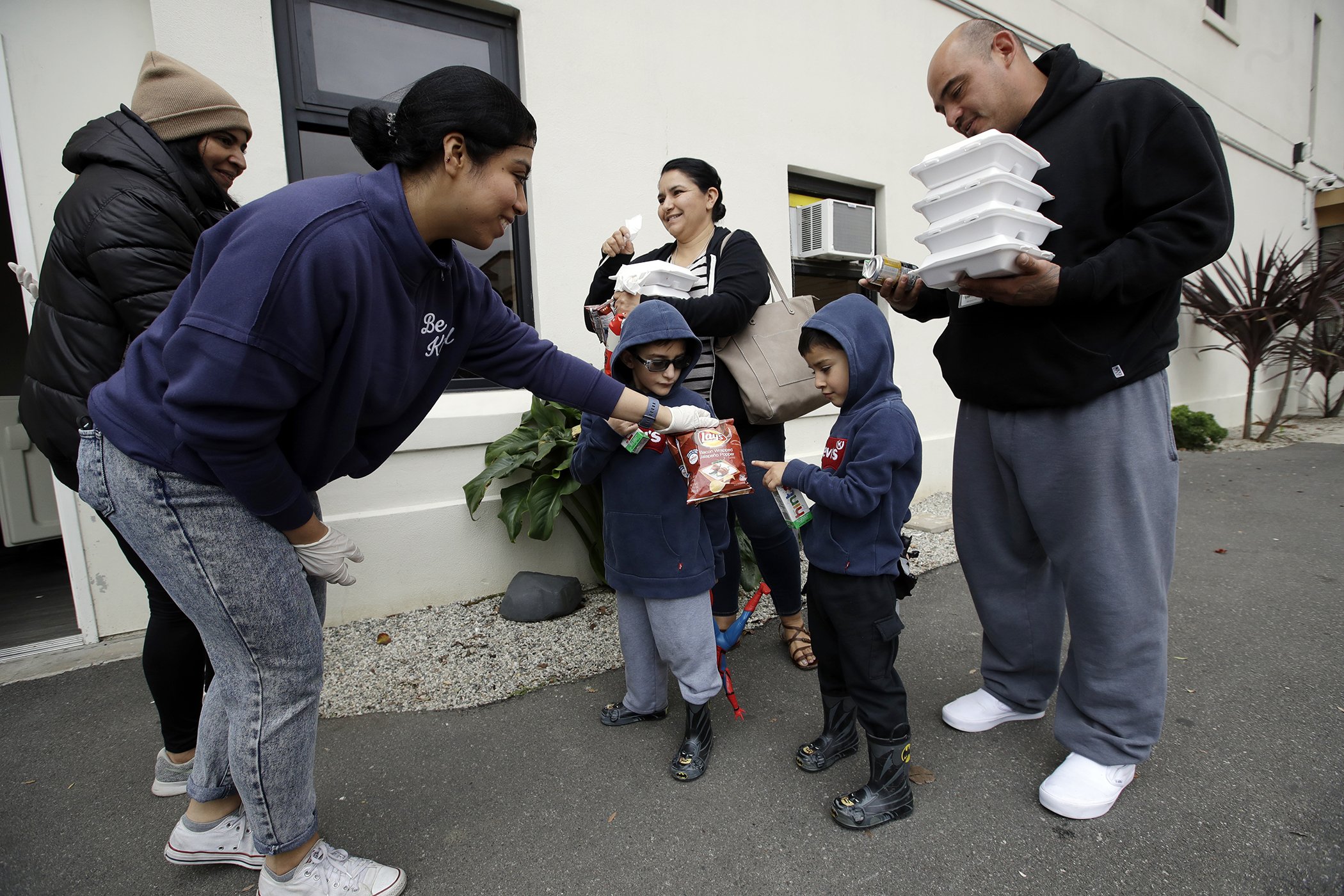 Volunteer, Pahola Campos hands out lunches to the Garcia family at a food distribution center set up by the Dream Center for those in need due to the coronavirus outbreak, March 16, 2020, in Los Angeles.
Food banks are a critical source of stability for any community facing a crisis — whether it’s a tropical storm, economic recession, or pandemic.
As the pandemic worsens, food banks around the world will face increased demand and fewer volunteers.
You can donate to local food banks in your area to help families in need and, if you’re fully able to, you can volunteer at them to help sort and deliver supplies.
3. Daycare
As schools close around the world, parents are struggling to find ways to supervise their children during the day — this is especially true for people working in essential sectors such as healthcare and food.
Once again, communities are rallying to support people in a bind.
People who are suddenly working from home indefinitely are creating impromptu daycares and traditional day care centers are extending their hours to meet the demand.
You can help by searching online and on social media for impromptu day care initiatives in your community that you can support if you’re healthy and able to, and by reaching out to friends, family, and neighbors who may need extra support.
4. Remote teaching
Students who are home from school also have to maintain their school work amid the pandemic so that they can pick up where they left off once the pandemic subsides.
For students with unreliable internet connections, unstable home residences, and other disruptions this will be extremely challenging.
The United Nations Sustainable Development Goal 4 is achieving universal, quality education by 2030. Part of the goal includes providing students with a consistent, stable place to learn, and the ongoing pandemic is undermining this previously certain variable for many students.
Some internet providers are making wireless connections free for students to ensure their school lessons can continue. Various educators are also providing virtual lessons and educational content to help students stay engaged while stuck at home.
Nonprofits like Scholastic, Save the Children, and UNICEF are stepping up to help students during this time. You can donate to these organizations, or support independent educators to promote education as the pandemic progresses.
5. Remote companionship
 A young boy plays his trumpet from a balcony, in Pamplona, northern Spain, Wednesday, March 18, 2020.
Social distancing is necessary to curb the pandemic. It’s also going to be isolating and emotionally draining for people worldwide who will be cut off from regular companionship.
In Italy, people have spontaneously orchestrated concerts from their balconies, while DJs and musicians are livestreaming sets for people.
Global Citizen has launched the #TogetherAtHome livestream series for musicians to share intimate concerts and create a sense of global community. So far, Chris Martin and John Legend have performed, with many more scheduled for the coming days. Check out our social media channels to find out who’s next, and tune in!
Meanwhile, virtual therapists have seen an exponential rise in demand, and friends everywhere are providing virtual support to each other.
You can help ease people’s isolation by checking in on friends and family members, and joining online communities to provide companionship to people who are alone.
6. Delivering goods and medicine
People who have COVID-19 or who are highly vulnerable to complications from it are advised to stay away from crowded areas. That presents an obvious dilemma: how are they going to get food and medical supplies?
Fortunately, volunteers are stepping up to meet the demand and assist people who are unable to use regular delivery services for financial or other reasons.
In Colorado, college students have created a service called “Shopping Angels” to shop for groceries and then deliver them to elderly people. In the UK, mutual aid groups are delivering medicine to people in need.
You can join these efforts by either delivering supplies to elderly people in your life, or by supporting groups that are providing this service — look online and on social media to find out about groups in your community.
“The most vulnerable don’t always have smart phones or internet access, so we have to figure out different nodes of connection,” Su said. “We have to figure out what their needs are and if we can connect existing resources to existing needs, and where there are needs beyond what we can provide as communities, we have to articulate these needs to elected officials.”
While community efforts to support each other are vital, we also need action from governments to ensure all countries have the capacity and resources to reach people who need assistance.
You can join Global Citizen in calling on governments to contribute more resources to the fight against the pandemic through out Stand Together to Beat Coronavirus campaign here. You can also take further actions like educating yourself about COVID-19 and how to stay healthy, and supporting and spreading the world on social media about the World Health Organization’s COVID-19 Solidarity Response Fund.

Joe McCarthy, Global Citizen, March 17, 2020
https://www.globalcitizen.org/en/content/how-is-coronavirus-being-contained/
Schools, restaurants, and entertainment venues are being shut down around the world to control the spread of the COVID-19 coronavirus pandemic.
Italy has enacted country-wide restrictions on travel following in the footsteps of China, which closed down the city of Wuhan, where the virus originated, to stop the contagion.
Major cities such as New York and London have since enacted similar restrictions of varying severity.
These are emergency public health interventions, a way to enforce “social distancing” to “flatten the curve,” two terms that have gained widespread attention in recent days.
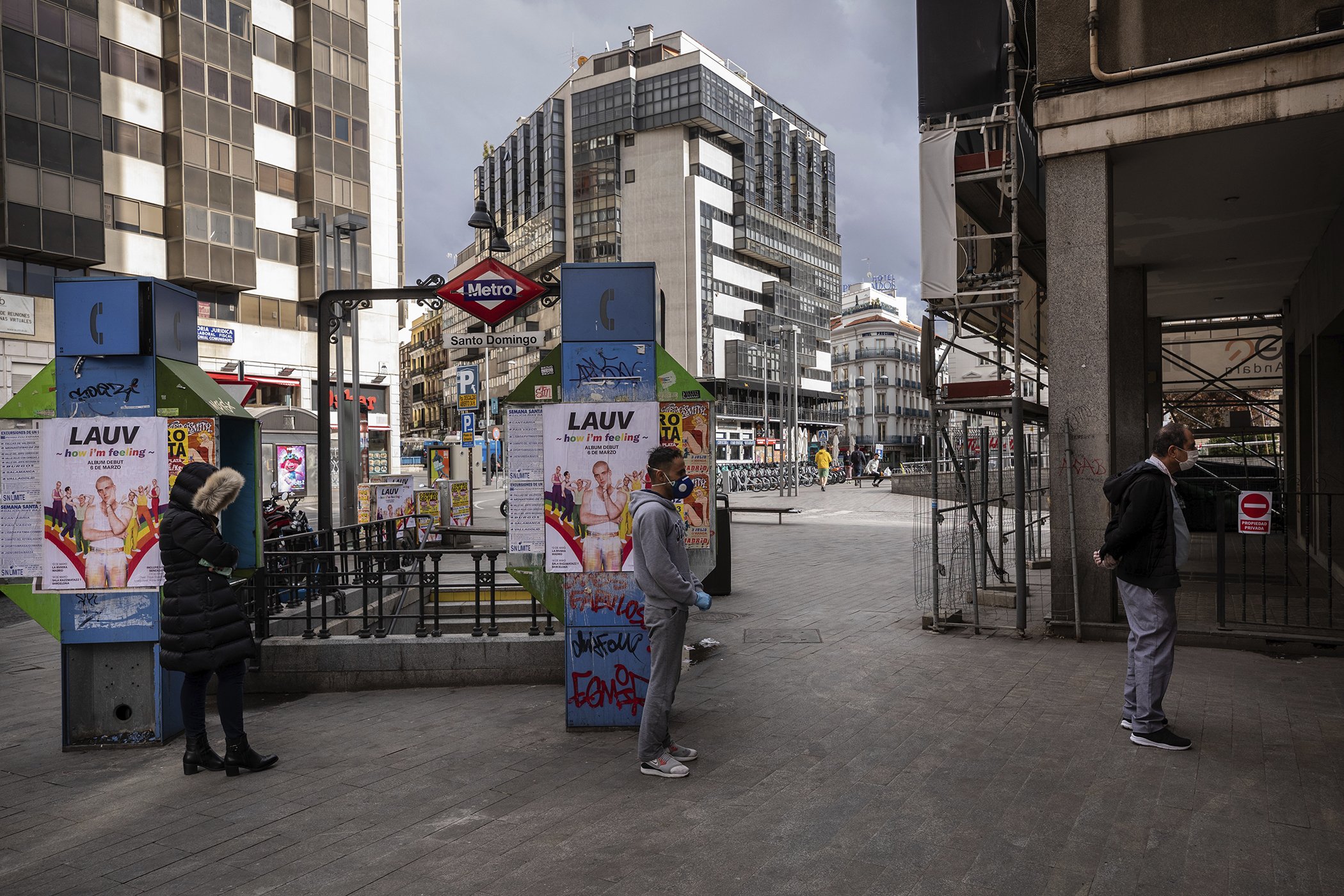 People, keeping a distance, queue in line in front of a shop downtown Madrid, March 16, 2020.
Social distancing calls on people to avoid large, public gatherings and highly-trafficked areas to minimize transmission rates, and flattening the curve refers to how the rate of infections will swiftly decline or “flatten out” if people practice social distancing, which also keeps health care systems from being overwhelmed.
“Social distancing has become the main way that local, state, and federal governments are trying to tackle the pandemic,” Christine Blackburn, deputy director of the pandemic and biosecurity policy program at Texas A&M University, told Global Citizen. “Overall, that’s really the most effective thing that we can do right now, other than washing our hands and practicing good cough hygiene. The number one way to try to prevent this from spreading is to avoid contact with other people.”
Priority #1: Flatten the curve. pic.twitter.com/TRjKlQ4H4Z
— Marc Benioff (@Benioff) March 12, 2020
In the past, outbreaks of diseases such as polio were partly contained through social distancing — children avoiding parks and schools — which bought researchers time to work on a vaccine that would prevent future crises. Just last year, unvaccinated children were banned from public spaces in Rockland Country during New York’s measles outbreak.
In order for social distancing to work, it needs to be quickly accepted and put into effect by the general public. These efforts can be undermined by misinformation and a lack of participation. Some young people don’t seem to be taking coronavirus seriously because they don’t believe it can harm them, which causes them to neglect social distancing guidelines, according to Anthony Fauci, director of National Institute of Allergy and Infectious Diseases.
“Even though you don’t get seriously ill, you could bring it to a person who would bring it to a person that would bring it to your grandfather, your grandmother, or your elderly relative,” he said at a recent press conference. “That’s why everybody’s got to take this seriously, even the young.”
Blackburn said that government officials and news organizations have to combat misinformation with clear and consistent updates.
“Communication is essential,” she said. “Consistent, effective, factual communication.”
The World Health Organization (WHO) and the US Centers for Disease Control and Prevention (CDC) have become important sources of information for the public.
Political leaders, in particular, have a responsibility to steer the general public toward high quality information, according to Celina Su, the Marilyn J. Gittell chair in urban studies at the City of New York Graduate Center.
“We look to local leaders to give us the vocabulary on how to approach this,” Su told Global Citizen. “We need some guidance on what we can do, we need ideas, and a general direction of thinking about how we might provide care for each other and respond to this crisis.”
Containment efforts are being put into place amid great uncertainty regarding the scale of the crisis and its potential to cause harm — up to 70% of the global population could end up infected by COVID-19, although the number could be far lower if the outbreak is contained. As a result, government responses have varied, with some urging for public shutdowns and others resisting calls for greater containment.
So far, 173,000 cases of the virus have been confirmed in 152 countries, and at least 7,000 people have died from it, according to the WHO’s real-time tracker. The number of infections is likely far higher, but a combination of factors including a lack of testing capacity, the fact that the virus can remain dormant for several days, and the minimal symptoms experienced by most victims make it difficult to know the full tally.
 Laurie Kuypers, a registered nurse, reaches into a car to take a nasopharyngeal swab from a patient at a drive-through COVID-19 coronavirus testing station for University of Washington Medicine patients, March 17, 2020, in Seattle.
The sooner government leaders enact containment measures, the less likely the disease will spread, the safer populations will be, and the earlier the world can move beyond the pandemic, according to the WHO.
Warnings about the dangers of inaction have already emerged.
In Italy, a multi-week lag between the arrival of COVID-19 and stringent government controls over public gatherings caused the number of infections to explode, according to Wired.
Officials in other countries where the disease is beginning to spread can use Italy as an example to advocate for precautionary measures to temporarily shut down places where COVID-19 can spread to flatten the curve.
Containment measures are more effective when combined with rapid and widespread testing, according to the WHO.
During the 2014-2016 Ebola outbreak in West Africa, for example, the WHO reports that a lack of testing capacity hampered the recovery effort because health workers were limited in their ability to treat those affected, and government officials were unable to map out the crisis and allocate resources.
The SARS outbreak of 2003, on the other hand, was rapidly contained because countries collaborated to rapidly track and report all new cases.
The efficacy of testing protocols can be seen in real time during the current pandemic. In South Korea, the government made tests widely available and curbed the disease’s outbreak. In the US, on the other hand, a massive shortage of coronavirus tests has created mass confusion by making it unclear how many people are infected.
“We cannot get an accurate picture of spread in the United States if we are not able to test people,” Blackburn said.
The main priority amid this crisis is the health and well-being of people around the world, particularly within vulnerable communities.
However, the pandemic will have repercussions far beyond health. Already, economies are veering toward depressions, with people losing their jobs, and businesses facing closure. These impacts have to be contained, as well. In fact, they’re intertwined: if economies collapse, then the health crisis could worsen.
 A woman walks through a lightly trafficked Times Square in New York, March 16, 2020.
“The Nobel-winning economist Amartya Sen is famous for arguing that no famine occurs in a functioning democracy,” Su said. “This pandemic shows that so much about how we address poverty and precarity, and how adequate our response is, similarly reflects the health of our democracy.”
Barbara Hoopes, associate professor of business, information, and technology at Virginia Tech, told Global Citizen that flattening the curve applies to areas beyond infection rates.
To minimize the economic fallout, or flatten the economic curve, countries have to invest heavily in social safety nets, provide relief to small businesses, and develop relief packages to help communities endure the pandemic.
“I think all the noise about flattening the curve is really good in general,” Hoopes said. “It allows the health care system to be resilient and keep up with the demand for health services, but [flattening the curve] is also an important thing for people to understand in their general lives [in terms of supply and demand].”
“It’s not a panic situation as much as it is a planning situation,” she added.

It’s never been clearer that we’re all Global Citizens, and we all have a part to play
Imogen Calderwood, Global Citizen, March 12, 2020
https://www.globalcitizen.org/en/content/how-to-help-fight-coronavirus-COVID-19/
The spread of COVID-19, the novel strain of coronavirus, has officially reached pandemic proportions this week.
But, as highlighted by World Health Organization Director-General Dr. Tedros Adhanom Ghebreyesus, during a press conference on Wednesday: “We cannot say this loudly enough, or clearly enough, or often enough. All countries can still change the course of this pandemic.”
In the current crisis, many of us are feeling worried about what it might mean for ourselves and our loved ones. It’s easy to feel helpless, but it’s never been clearer that we’re all Global Citizens, and there are actions we can all take to fight for a world with good health for all.
On Friday, Global Citizen launched a new campaign to support the fight against COVID-19, and we need your voice to call on world leaders to help solve this health crisis.
Here are three actions you can take right now.
1. Call on World Leaders to Step Up WHO Funding
We need your help to urge leaders of the G20 countries to ensure that the WHO has the financing it needs to respond to COVID-19 and to future health crises.
Responding to a health crisis on this scale requires every country to have a health infrastructure that can cope with the additional strain of treating patients and managing the spread of the virus.
Many countries have already taken action and responded to the outbreak with emergency funding. The UK has provided £46 million of UK aid to help find a vaccine to fight the disease, including a large contribution to the WHO. Canada announced a commitment of $1.1 billion in response to the outbreak, which included $275 million earmarked for research and vaccine development, and $50 million specifically set aside to help with response efforts globally. The US announced on Tuesday that it would spend up to $100 million to tackle the outbreak overseas.
Still, more funding is needed to protect those most at risk — including people in the poorest communities, unable to stop its spreading.
That’s why Global Citizen is calling on world leaders to step up and commit additional funding to the WHO’s response efforts. You can take action on this here.
2. Support the WHO’s Solidarity Fund
On Friday, the WHO launched a first-of-its-kind COVID-19 Solidarity Response Fund, powered by the UN Foundation and Swiss Philanthropy Foundation.
It’s a historic fund that companies, foundations, and individuals can donate to in order to support the WHO’s global response to the ongoing outbreak.
The fund is expected to attract millions of dollars in contributions from major companies, and will become the leading mechanism worldwide for businesses, philanthropies, and individuals to contribute, according to the WHO’s statement.
The WHO has anticipated a need of $675 million through April alone for preparedness and response efforts. But as the outbreak evolves, funding needs are likely to increase.
Contributions to the fund will play a critical role in supporting global efforts, including tracking and understanding the spread of the virus, and ensuring patients get the care they need, while frontline workers get supplies and information.
Facebook is matching the first $10 million donated, so people are encouraged to donate during that time.
You can support by sharing news of the launch of the Solidarity Respond Fund on your social media, and by calling on your friends and family to donate to the fund.
3. Keep Healthy
The World Health Organization (WHO) and national health services have issued advice to help keep yourself and loved ones healthy, including committing to practicing good hand-washing techniques and following social distancing rules.
In a pandemic, individuals can contribute to helping stop the spread of the virus by staying home if you’re unwell and working from home if you can.
Action starts with learning the facts about the virus and the health measures we can all be taking to keep ourselves safe, and we can all better protect ourselves and those around us.
You can test your knowledge on the virus and learn how we can all be safe and responsible Global Citizens in the face of COVID-19 here.
In the past two weeks, the number of cases of coronavirus reported outside of China has increased by more than 13-fold as the virus continues its global spread. According to the WHO, the number of cases could continue to rise exponentially in the weeks and months ahead, which is why action now is so important.
The WHO is calling on countries to work together to limit the spread of the virus, including investing heavily in public health measures, and in sharing expertise, funding, and best practices with other countries.
Over the past decade, Global Citizen has campaigned in support of strengthening health systems around the world. That’s because strong, resilient health systems are not only able to cope with outbreaks of disease, but they are also vital in preventing and mitigating the loss of life, social disruptions, and the devastating economic impact disease outbreaks can have on communities.
The only way to contain and prevent catastrophic outcomes is to invest in strengthening health systems everywhere, especially in the world’s poorest countries.
“This is not just a public health crisis, it is a crisis that will touch every sector — so every sector and every individual must be involved in the fight,” Dr. Tedros said.
You can learn more and start taking action on our Stand Together to Beat Coronavirus campaign page.