

Click the image above to watch…
Dr. Maalouf’s caption on the X post is, “Every woman should fear this.”
What a repulsive notion, that we need to take the position of accepting the inevitable forcing of cultural subversion by Islam. Fear actually kills. It kills creative expression and the unique aspects of both national tradition and individual freedom. The warning is certainly warranted. None of these seismic shifts in daily life took place quietly or organically over time.
One wonders at the ideology of hiding every aspect of a woman’s beauty head to toe. I did watch a video of an imam speaking of the importance for women to cover up, and it’s primarily because the men of Islam are absolute perverts at heart with no self-control whatsoever, no manners, and certainly no respect.
Nope. We ain’t havin’ it. The cultural divide is abysmally wide and unlikely to ever be bridged. Here’s a breakdown of the devolution into darkness:
Iran ~ This was the most dramatic and sudden shift. Before 1979, under the Pahlavi monarchy, veiling was actually banned in public institutions (since Reza Shah’s 1936 Kashf-e hijab decree), and many urban women wore modern Western clothes freely.
After the 1979 Islamic Revolution, Ayatollah Khomeini quickly decreed mandatory hijab (starting with government offices in 1979–1980, fully enforced by law in 1983 with punishments like fines or lashes). Women protested en masse in March 1979, but the change was imposed rapidly by the new regime, not a quiet gradual process.
Afghanistan ~ Similarly sharp reversals. In the 1960s–1970s (pre-Taliban and pre-Soviet invasion), especially in Kabul, many women wore modern clothing, attended university, and worked without strict veiling. The Taliban’s first rule (1996–2001) imposed full burqa, banned women from public life without a male guardian (mahram), and enforced it brutally and immediately.
After the 2001 U.S. invasion, freedoms returned for 20 years, but the 2021 Taliban takeover reimposed the same extreme restrictions almost overnight ~ bans on education beyond primary level, work restrictions, mandatory full covering, and no gradual transition.
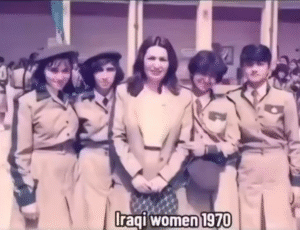
Egypt, Iraq, Syria — These were more mixed, with some gradual elements but still significant political/ideological drivers. In the mid-20th century (1950s–1970s), urban women in these countries often wore Western or secular styles, and veiling was uncommon or optional among the middle/upper classes.
A resurgence of hijab began in the 1970s–1980s, influenced by the global Islamic revival (partly inspired by Iran’s 1979 revolution), Gulf migration (bringing back conservative norms), and rising Islamist movements. In Egypt, for example, hijab adoption rose sharply from the 1980s onward due to social pressure and economic factors, reaching high levels by the 2000s — more gradual than outright bans, but not “quiet” as it involved visible cultural and political debates.
Iraq and Syria saw similar trends, though without full legal mandates like Iran/Afghanistan; enforcement came more through social norms, militias, or post-conflict Islamist groups rather than a single sudden decree.

Many countries around the world have laws about face coverings now…
- France — First European country to enact a full public ban in 2011 (fines up to €150).
- Belgium — Nationwide ban since 2011 (fines and possible jail time).
- Denmark — Ban on full-face veils in public since 2018.
- Austria — Ban in public since 2017.
- Bulgaria — Ban in public since 2016.
- Netherlands — Ban in public buildings, transport, schools, hospitals since 2019.
- Switzerland — Nationwide ban on face coverings in public (effective 2021 referendum, implemented 2025).
- Italy — Recent nationwide ban approved in 2025 (fines proposed).
- Portugal — Ban approved in parliament in 2025 (awaiting final approval; fines up to €4,000).
- Cameroon — Ban in the Far North region since 2015 (due to terrorism concerns).
- Chad — Nationwide ban since 2015 (post-terror attacks; Muslim-majority country).
- Gabon — Ban in public.
- Republic of the Congo — Ban in public since 2015.
- Sri Lanka — Ban on face coverings since 2019 (post-Easter bombings).
- Tajikistan — Muslim-majority; full ban on face veils (and hijab restrictions) in recent years.
- Kazakhstan — Muslim-majority; nationwide ban on burqa/niqab effective 2025.
- China — Ban in Xinjiang region (targeted at Uyghur practices).
- Tunisia — Muslim-majority; restrictions or bans in certain public/government contexts.
- Morocco — Ban on sale/import of Afghan-style burqa since 2017 (other veils allowed).
Other Countries with Partial Restrictions or Discussions: Norway, Latvia, Luxembourg, Kyrgyzstan, Uzbekistan, Azerbaijan, Kosovo, Turkey, Algeria — Often limited to schools, public institutions, or specific settings.
Canada (Quebec province) — Restrictions on face coverings for public services.
I noticed the UK is not on the list. The “elected” officials there certainly have shown their hand in terms of what they want for Britain, and it’s nothing good for the British citizenry. We need to get serious in this country about addressing the threat of Islam. The whole “frogs in a pot” parable comes to mind: If you drop a frog into boiling water, the story goes, it’ll jump out. That same frog might actually enjoy a cool dip in the pot, but when the heat turns up slowly, our amphibious subject will adjust to the temperature until it eventually boils to death.
Gad Saad wrote a book about suicidal empathy, which notion is certainly not new. Our innate human compassion has been used against us for far too long, and we need to recognize when it morphs into idiot compassion, which truly helps no one.