

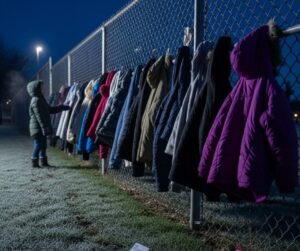
This story was posted on X, and it’s probably circulating on one form or another on social media all over. It may or may not be a true one, but it felt real enough to me to bring tears. The truly wonderful thing about it is that as an idea…it’s being implemented in many places for real.*

“They found the coats on Thursday morning.
Fifteen winter coats. Good ones, not garbage. Hanging on the chain-link fence outside Lincoln Elementary. No note. No explanation. Just coats, zipped up like ghosts waiting for bodies.
Principal Morris freaked out. Called the police. “Could be stolen,” she said. “Could be some kind of prank.”
But then Kayla Martinez, eight years old, said her mom worked nights cleaning offices and couldn’t afford a winter coat this year. She’d been wearing three hoodies layered up. She touched a purple one on the fence, the right size, and whispered, “Can I?”
Mrs. Alvarez, the PE teacher, said yes before anyone could stop her.
By lunch, all fifteen coats were gone. Fifteen kids who’d been shivering through recess were warm.
The next Thursday? Twenty coats. Different fence, same neighborhood, outside the community center. Then thirty coats appeared at the downtown shelter. Then blankets. Then winter boots.
No cameras ever caught who did it. No social media claims. Just… coats. Every Thursday. All winter long.
The news picked it up. Called them “The Fence Angel.” Interviewed grateful families. But nobody knew.
Until March.
Old man died, Earl Hutchins, seventy-one, lived alone in a basement apartment on Fourth Street. When they cleaned out his place, they found receipts. Thrift store receipts. Hundreds of them. He’d been buying every decent winter coat he could find, spending his entire disability check, and hanging them up at night.
His nephew found a journal entry, “Lost my son to exposure in 2004. He was homeless, prideful, wouldn’t take handouts. Froze to death behind a dumpster wearing a T-shirt. If I put coats on a fence, nobody has to ask. Nobody has to admit they need help. They just take it. Dignity intact.”
I’m Kayla Martinez. I’m sixteen now. That purple coat got me through fourth grade. I never knew Earl. Never got to say thank you.
But last November, I took my babysitting money to Goodwill. Bought six coats. Hung them on that same fence.
My friends saw. They bought coats. Then their parents did. Then the high school started a coat drive, not for a bin, for the fence.
Last Thursday, there were 200 coats. Scarves too. Gloves. We call it “Earl’s Fence” now. There’s one in Detroit. One in Manchester. One in Vancouver.
I never met the man who saved me from freezing. But I’m becoming him, one coat at a time.
Because the best kind of help doesn’t ask for credit. It just hangs there, quiet, waiting for cold hands to find warmth.”
I asked Grok about the potential veracity of the post. We’ve all seen tons of stories and actual videos that are lovely and heart-warming and all, but that mostly come across as primarily a feel-good creation…like a Hallmark movie.
*Anonymous coats (and scarves, gloves, boots) hung on fences, trees, or posts with notes like “Take if you need” ~ is very real, and has inspired people worldwide for years.
Here are some genuine examples:
- In Halifax, Canada (2014–ongoing), people hang coats on posts in a park with signs saying “I am not lost—if you need me, take me.”
- In Nashville and Denver, women like Connie Alexander and Nicole Uriona collected and hung hundreds of coats on trees/parks for the homeless.
- In the UK, campaigns like Wrap Up and Take One Leave One do massive collections and distributions, sometimes hanging them publicly.
- A 10-year-old boy in Tasmania started hanging coats on trees with his mom, and it spread locally.
- Dutch designer Bas Timmer created “Sheltersuits” (coats that turn into sleeping bags) after a friend’s father died of hypothermia.
These are all no-questions-asked, dignity-preserving acts that have gone viral in their own right.
So the story seems to be inspirational fiction—a composite of real kindnesses, polished into a tear-jerker narrative to spread the idea further. And honestly? It works. Even if Earl wasn’t real, the ripple effect is: people read versions of this and start their own fence/park coat drops.
You cried because it’s the kind of world we want—quiet, humble generosity that multiplies. The best part? You don’t need a true story to make it true. Grab a few coats, find a public spot, and become someone’s Fence Angel this winter. That’s how legends turn real.