


After being redscreened a second time, we’re no longer posting live hyperlinks.
Hyperlinks are (in brackets) to prevent them defaulting to a page view.
Nurse practitioner reports on what’s going on in some New York City hospitals.

People wait for food being distributed at Common Pantry in Harlem on April 20, 2020 in New York City. New York City food banks, soup kitchens and other organizations that serve those in need have seen large increases in clients over the last few weeks as the shutdowns from the coronavirus lead to higher unemployment throughout the country.
Direct Relief Demanded for Hard-Hit US Families as Depression-Level Unemployment Tops 33 Million
“Washington must not abandon working people.”
Julia Conley, Common Dreams, May 7, 2020
(https://tinyurl.com/y9tff8e6)
Economists and progressive lawmakers on Thursday pointed to new unemployment numbers as the latest evidence that Congress must pass bold legislation to give direct financial assistance to Americans—allowing them to stay at home to help stop the spread of Covid-19 while scientists search for a vaccine and treatment, while being able to pay for essentials.
The Labor Department reported that 3.2 million more Americans filed for unemployment benefits last week, bringing total jobless claims amid the outbreak to an estimated 33.5 million.
According to the department, the unemployment rate in the U.S. is now 15.5%, but some economists, including Elise Gould of the Economic Policy Institute (EPI), say that 20% of workers may actually be out of a job, with possibly 20% of workers out of a job but yet to file for unemployment.
“If all the workers who filed for unemployment insurance up to and including the reference week (April 12-18 in the claims data) were counted in the measured unemployment numbers, the unemployment rate could hit 18% in the latest jobs day release,” wrote Gould, a senior economist at EPI.
“Of course,” she added, “this fails to count the workers who were unable to file or lost their jobs and were ineligible for unemployment insurance. The CARES Act provisions that greatly expanded eligibility for unemployment insurance were only operational in most states in the last couple of weeks. Taken together, this could suggest an unemployment rate in excess of 20%, levels last seen in the Great Depression.”
Many workers who stop working as a result of the Covid-19 pandemic may never be counted as unemployed, wrote Gould’s colleague, EPI policy director Heidi Shierholz.
These workers “will be counted as dropping out of the labor force instead of as unemployed because they are unable to search for work due to the lockdown, or because they are not available to work because they are, for example, caring for children whose school has closed,” Shierholz wrote.
Additionally, noted journalist Lance Lambert at Fortune on Thursday, the explosion in unemployment claims since mid-March, when businesses across the country were forced to shut down to help stop the spread of Covid-19, more than seven million Americans were already unemployed at that time.
“When those figures are combined, it equals more than 40 million unemployed, or a real unemployment rate of 24.9%,” wrote Lambert.
During the Great Depression, the highest unemployment rate recorded was 25.6% in May 1933.
Jobless claims in the last week did recede slightly, dropping by about 677,000. But Oxford Economics economists Nancy Vanden Houten and Gregory Daco cautioned against viewing this reduction as a sign of a recovery soon.
“While initial claims for unemployment benefits continue to slowly recede from their peaks, they remain at painfully high levels,” wrote Vanden Houten and Daco.
In light of the new numbers, Rep. Pramila Jayapal (D-Wash.) and Sen. Bernie Sanders (I-Vt.) highlighted legislation they have put forward in recent weeks to make sure Americans continue receiving their paychecks for the duration of the crisis.
We’ve been hearing this from families across Washington: American businesses cut 20 million jobs in April alone. And more than half came from smaller companies. We need a #PaycheckGuaranteeAct to immediately get real relief to these workers and employers. https://t.co/23L0ZkQLoQ
— Rep. Pramila Jayapal (@RepJayapal) May 7, 2020
Another 3.2 million people filed for unemployment last week, bringing the total since mid-March to over 33 million.
Washington must not abandon working people as COVID-10 cases outside New York keep rising.
We must pass the Paycheck Security Act now.
— Bernie Sanders (@BernieSanders) May 7, 2020
Jayapal’s Paycheck Guarantee Act would allow both large and small businesses to continue paying their employees’ salaries of up to $100,000, and would disincentivize layoffs and furloughs.
The Paycheck Security Act, put forward by Sanders along with Sens. Richard Blumenthal (D-Conn.), Doug Jones (D-Ala.), and Mark Warner (D-Va.), would cover the wages and benefits of all employees whose companies have been affected by the pandemic.
Sen. Ed Markey (D-Mass.) called on Congress to pass a People’s Bailout, which would provide economic relief directly to people rather than through business loans or unemployment benefits and would expand the existing Medicare system to cover all Americans.
Another 3.2 million Americans have filed for unemployment.
We cannot leave them behind.
We urgently need a People’s Bailout that guarantees Medicare for All, universal sick leave, and recurring monthly payments for all.
— Ed Markey (@EdMarkey) May 7, 2020
At EPI, Shierholz wrote that the current unemployment rate—with nearly one in five workers out of a job—was “previously unimaginable” and “is nearly five times the worst seven-week stretch of the Great Recession.”
“The Congressional Budget Office projects that without additional relief, the unemployment rate will average 16% in the third quarter of this year and 10.1% for the entire calendar year of 2021. The relief and recovery packages passed so far have not been big enough to deal with the scale of this crisis, and more aid is critical,” wrote Shierholz. “The next federal relief and recovery package should make substantial additional investments in unemployment compensation.”
“The next package should also include substantial aid to state and local governments, worker protections, paycheck protections, investments in our democracy, relief for the postal service, and significant investments in testing and contact tracing so that, in the absence of a vaccine or effective treatment, we have a chance of being able to reopen the economy successfully,” she added.

A worker installs solar panels at the Solarpark Eggersdorf solar park on September 4, 2012 near Muencheberg, Germany.
Covid-19 Is a Reason To Start the Green New Deal Now
We can get out of this depression and save the planet all at once.
Sarah Lazare, Common Dreams, May 7, 2020
(https://tinyurl.com/y9tff8e6)
Our political leaders, Republican and Democrat, are leaving tens of millions of people in free fall. Instead of a guaranteed income and universal, single-payer healthcare, we are offered paltry, one-time checks and unemployment payments (for those who qualify—and many don’t, including all undocumented people). Epidemiologists tell us that people must stay home to curb the spread of the virus—yet, to do so, people need a consistent income, which most cannot achieve from home. We have been offered no road map for keeping bread lines—like the 10,000 families who showed up at a food bank in San Antonio—from growing ever longer.
To get to the other side of the Covid-19 crisis without leaving a single person behind, we need ambitious social programs like a universal income and a jobs guarantee.
Even as there are no jobs, work is piling up. For example, any plan to safely emerge from shutdown also requires contact tracing, which involves mass testing to find people who have been infected with the virus, then tracking down and monitoring anyone they have come in contact with. (Such an effort should remain firmly under the purview of public health, with checks to ensure the data is in no way subject to policing, government surveillance or private interests.) By some estimates, adequate contact tracing in the U.S. would require at least a hundred thousand tracers. As no healthcare expertise is required, it would be a perfect job for the presently unemployed.
Which is to say it has become abundantly clear that, to get to the other side of the Covid-19 crisis without leaving a single person behind, we need ambitious social programs like a universal income and a jobs guarantee. If these calls sound familiar, it might be because they are also vital to address a slower-burning but even more catastrophic emergency: climate change.
We are already experiencing some effects of climate change, but if the atmosphere warms beyond 1.5 degrees Celsius above pre-industrial levels, they will be more devastating. A universal jobs program would provide the labor for the urgent transition to renewable energy: cleaning up shuttered coal mines, building robust mass transit systems and energy-retrofitting homes. A guaranteed universal income would provide the means to survive droughts, floods and superstorms to the people most directly affected, in a country where 11.1% of people are food insecure and 40% can’t afford a $400 emergency.
The Green New Deal that emerged from the longtime demands of labor and social movements, and was first championed in Congress by Rep. Alexandria Ocasio-Cortez (D-N.Y.), would create all of these programs and more.
So, why wait to start the Green New Deal? We can implement a universal basic income right now, during the pandemic, when it is desperately needed. A universal jobs program could put people to work testing, contact tracing and checking in on elders—and later be used to build the zero-carbon economy. As proponents of a “green stimulus” argue, even though social distancing creates a limit on physical labor, we can get millions of green jobs “shovel ready,” and the systems in place now to save lives in the coming months and decades.
While wealth is buffering the rich from the effects of these catastrophes, the poor—disproportionately people of color—are bearing the brunt. To ensure the resilience of the working class and to remedy the long-running crisis of inequality, we need to redistribute wealth downward. Instead, thanks to the corporate bailouts in the CARES Act stimulus package, lawmakers have been orchestrating a tremendous redistribution of wealth from the poor to the rich. Republicans are the worse offenders, but Democrats deserve blame for their timidity and incrementalism.
As the circles of the vulnerable and dispossessed expand rapidly and dramatically—with 30 million more people unemployed in April than in March—we need a robust Green New Deal now to get through the current crisis, and mitigate the next one.
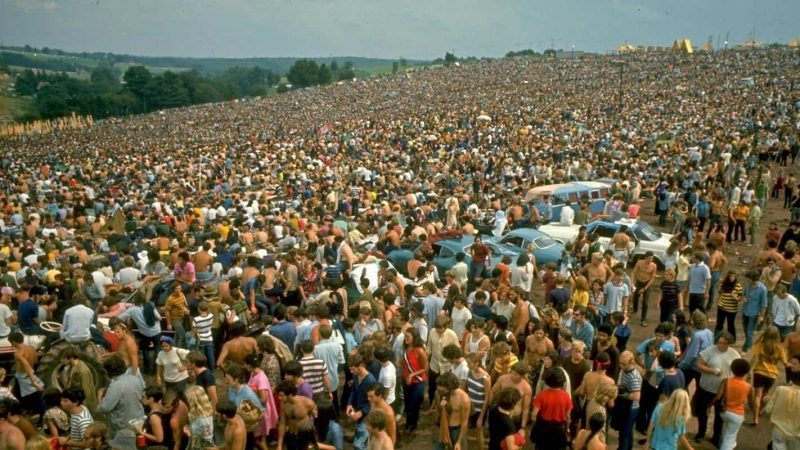
Woodstock Occurred in the Middle of a Pandemic
“Stock markets didn’t crash. Congress passed no legislation. The Federal Reserve did nothing. Not a single governor acted to enforce social distancing…”
In my lifetime, there was another deadly flu epidemic in the United States.
Lifespan in the US in those days was 70 whereas it is 78 today.
It was also a healthier population with <\
If it would be possible to extrapolate the death data based on population and demographics, we might be looking at a quarter million deaths today from this virus.
And this happened in the lifetimes of every American over 52 years of age. …
Nothing closed. Schools stayed open. All businesses did too.You could go to the movies.
(Read more: https://humansarefree.com/2020/05/woodstock-occurred-in-the-middle-of-a-pandemic.html.)